Job loss is linked to depression, anxiety, loss of purpose, and a sense of dissatisfaction. Layoffs and changing political priorities dominate the news cycle as contributors to job uncertainty. But we don’t talk enough about unemployment, push out, and the black sheep phenomenon.
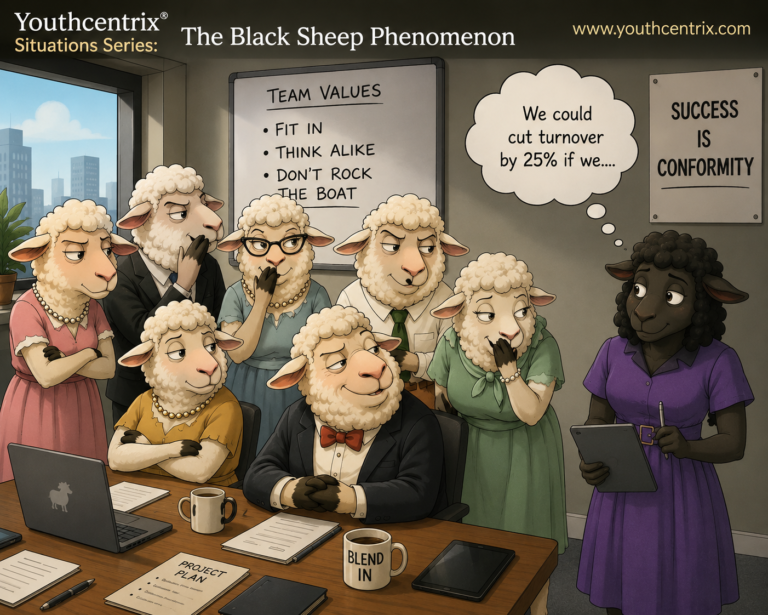
The pattern of calling out what’s wrong or what could be improved contributes to job loss and isolation. Particularly when change meets resistance. And it usually does. The push and pull is amplified when you’re not a favored player in the social system.
There is indeed a process to change management and thus to being an effective disruptor (black sheep).
Timing.
Place.
Champions.
Trust.
Hard truths resonate with the change-ready (i.e. the small cohort of early adopters). For the rest of the population, Process is king.
Understanding the science of change presents an opportunity for self awareness when you’re the one who feels compelled to speak up.
And one of the hard truths for black sheep is: too often it’s not your business to run nor your team to lead.
You’re not in charge.
And were you asked to solve the issue?
What many see as willful choice to conform or disrupt is less about weakness or courage and is far more instinctive.
A black sheep isn’t just seeing and behaving differently…they are wired differently. Likewise, a conformist has a different risk tolerance and could see the same issue and simply ignore/adapt without the disquieting cognitive dissonance.
A black sheep doesn’t.
Perhaps cannot.
Or will not.
We could label that cognitive pattern as emotional im/maturity, over attachment to outcomes, or over performance.
I see the black sheep as a convergence of relatively high values integrity, agency sense, outcomes forecasting for the system they’re in, and relatively low importance for social kinship/acceptance by an “imperfect” climate.
The Resolution: Be a problem finder/solver where (and in a way) solutions are sought rather than resisted.
Rather than experiencing burnout, repeated frustration, and isolation, the firm organizational resistance you see may be a sign that it’s time to
•move on,
•adapt by exercising personal integrity rather than pursuing systemic change, or
•build a values-aligned ecosystem where you direct culture and process.
But if you care that much…before you move on, try to build alliances with leadership and org influencers who will convert your effort from an annoyance into a pilot.
(Family black sheep are a different story.)
For years, I’ve been intrigued by the social and personal psychology of the black sheep phenomenon.
How are problem finders treated in your organization? How do you manage the sense of being the black sheep?
-Dr. Denise Long-
