YOUTHCENTRIX®

  • Home
  • Allied & Behavioral Health
  • Implementation Consulting
  • The TIPS Learning Lab™
    • Just-In-Time Professional Development
    • Blog
  • Contact Us
  • Information Technology
  • Inpresence
    • Inpresence InInpresence Privacy & Safety Policy
    • Inpresence Support

July 23, 2026 By Youthcentrix

How Trauma Shapes the Brain: Understanding Triggers, Meaning-Making, and the Four Stress Responses

Why do two people experience the same event but respond in completely different ways?

Why does a seemingly ordinary situation trigger intense fear, anger, withdrawal, or compliance in one person while another barely notices it?

The answers begin with understanding how the brain makes meaning from experience.

Every experience teaches the brain something about the world. Some experiences reinforce feelings of safety, connection, and trust. Others communicate danger, uncertainty, or loss. Over time, these experiences shape the brain’s expectations about what is safe, what is threatening, and how to respond when challenges arise.

When adversity becomes overwhelming or chronic, those experiences can become trauma. Trauma changes more than memories. It influences how people interpret new situations, how they recognize potential threats, and how automatically their brain responds in an effort to survive.

This training explores how trauma shapes the brain, how memories become triggers, and why fight, flight, freeze, and fawn are not character flaws or intentional choices. They are automatic survival responses that develop to protect us when the brain believes danger is present.

What You’ll Learn

By the end of this lesson, you will understand:

  • How the brain creates meaning from experience
  • Why traumatic experiences become lasting memories
  • The difference between memories and triggers
  • How the brain’s survival system influences behavior
  • The four primary stress responses
  • Why stress reactions are protective rather than personal
  • How a trauma-responsive perspective changes the way we understand behavior


Watch the Trauma Training Video

In this session, Dr. Pamela Denise Long explores how adversity becomes trauma, how the brain creates meaning from experience, and why fight, flight, freeze, and fawn are automatic survival responses rather than intentional behaviors.

Training Overview

This training explores how adversity shapes the brain’s understanding of safety, relationships, and survival. You’ll learn how traumatic experiences influence meaning-making, create memories and triggers, and lead to automatic stress responses such as fight, flight, freeze, and fawn. Whether you work in education, healthcare, behavioral health, public safety, leadership, or simply want to better understand yourself and others, these concepts provide a foundation for responding with greater insight and compassion.


Interested in bringing trauma-responsive practices to your organization? Contact Us.

Who Should Receive This Training?

This training is valuable for:

  • Educators and school staff
  • School administrators
  • Mental health professionals
  • Healthcare providers
  • Social workers
  • Child welfare professionals
  • Law enforcement officers
  • First responders
  • Community leaders
  • Human resource professionals
  • Parents and caregivers
  • Anyone seeking a deeper understanding of trauma and human behavior
Filed Under: How Trauma Shapes the Brain, Human Development, Trauma-Informed Resilience

July 21, 2026 By Youthcentrix

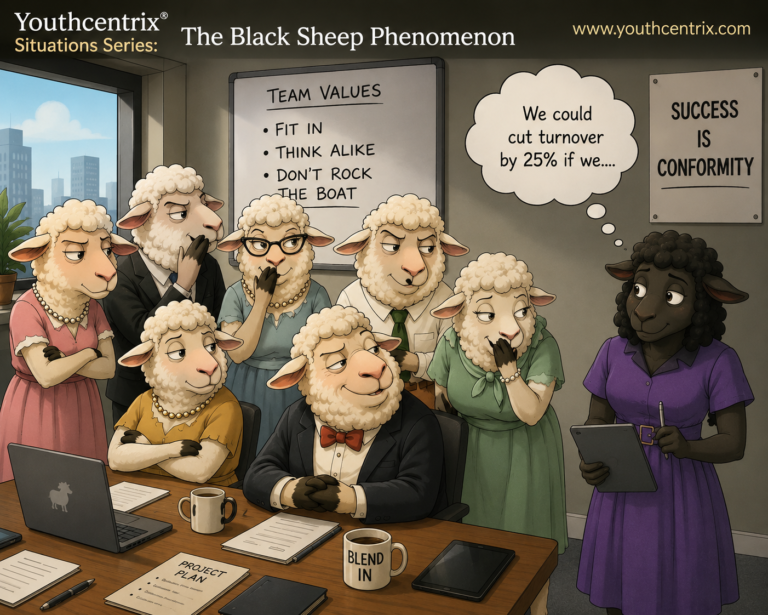
Situations Series: The Black Sheep Phenomenon, Push Out, and Unemployment

Job loss is linked to depression, anxiety, loss of purpose, and a sense of dissatisfaction. Layoffs and changing political priorities dominate the news cycle as contributors to job uncertainty. But we don’t talk enough about unemployment, push out, and the black sheep phenomenon.


The pattern of calling out what’s wrong or what could be improved contributes to job loss and isolation. Particularly when change meets resistance. And it usually does. The push and pull is amplified when you’re not a favored player in the social system.


There is indeed a process to change management and thus to being an effective disruptor (black sheep).


Timing.


Place.


Champions.


Trust.


Hard truths resonate with the change-ready (i.e. the small cohort of early adopters). For the rest of the population, Process is king.


Understanding the science of change presents an opportunity for self awareness when you’re the one who feels compelled to speak up.


And one of the hard truths for black sheep is: too often it’s not your business to run nor your team to lead.

You’re not in charge.

And were you asked to solve the issue?

What many see as willful choice to conform or disrupt is less about weakness or courage and is far more instinctive.

A black sheep isn’t just seeing and behaving differently…they are wired differently. Likewise, a conformist has a different risk tolerance and could see the same issue and simply ignore/adapt without the disquieting cognitive dissonance.

A black sheep doesn’t.

Perhaps cannot.

Or will not.

We could label that cognitive pattern as emotional im/maturity, over attachment to outcomes, or over performance.

I see the black sheep as a convergence of relatively high values integrity, agency sense, outcomes forecasting for the system they’re in, and relatively low importance for social kinship/acceptance by an “imperfect” climate.

The Resolution: Be a problem finder/solver where (and in a way) solutions are sought rather than resisted.

Rather than experiencing burnout, repeated frustration, and isolation, the firm organizational resistance you see may be a sign that it’s time to
•move on,
•adapt by exercising personal integrity rather than pursuing systemic change, or
•build a values-aligned ecosystem where you direct culture and process.

But if you care that much…before you move on, try to build alliances with leadership and org influencers who will convert your effort from an annoyance into a pilot.

(Family black sheep are a different story.)

For years, I’ve been intrigued by the social and personal psychology of the black sheep phenomenon.

How are problem finders treated in your organization? How do you manage the sense of being the black sheep?

-Dr. Denise Long-

Filed Under: Change Management, Executive Coaching and Development, Human Development, Human Resource Management, Trauma-Informed Workplace

  • Legal Policy
  • Privacy Policy
  • Cookie Policy
  • Contact Us


PHONE: +1 (314) 877-8754       EMAIL: info@youthcentrix.com

©2014-2026 Copyright YOUTHCENTRIX® THERAPY SERVICES, LLC. All Rights Reserved.